Why PIR Alone Falls Short for Modern Buildings
Passive infrared (PIR) occupancy sensors have been in commercial buildings for decades, and they work well for their original purpose: switching lights off in an empty room. The detection model is simple — movement produces a temperature differential in the sensor's field of view, the lens focuses that differential onto a pyroelectric element, and an output triggers. The limitation is inherent in the physics: a person sitting still at a desk, reading or typing, produces very little thermal movement. PIR misses stationary occupants regularly, and the standard workaround — adding a manual override button or setting a very short timeout — either annooys occupants or defeats the energy-saving purpose.
Camera-based occupancy systems can detect stationary occupants, but they introduce a privacy barrier that has become a significant obstacle in commercial real estate deployments. Building occupants, HR departments, and data protection regulations in an increasing number of jurisdictions are pushing back on camera-based people-counting systems, even when the stated purpose is anonymised counting rather than identification. The result: facility managers are caught between PIR's detection limitations and the compliance and consent overhead of camera systems.
How 60 GHz mmWave Radar Works for Occupancy
Millimeter-wave radar at 60 GHz (specifically the ISM band 57–64 GHz, unlicensed in the US under FCC Part 15) detects motion by transmitting FMCW (frequency-modulated continuous wave) signals and analyzing the reflected return. The key property is micro-Doppler detection: the radar can detect the micro-movements caused by breathing and cardiac activity at a range of 2–4 meters, even when the person is otherwise stationary. A person sitting at a desk, completely still, will have a chest displacement of roughly 5–10 mm per breath — well within the detection capability of a properly configured 60 GHz FMCW radar.
The Texas Instruments IWR6843 — the chipset used in the MK-NODE-OCC — is a single-chip 60 GHz FMCW radar with integrated DSP and ARM Cortex-R4 processor. It processes raw ADC samples on-chip through a configurable signal processing chain: range-Doppler FFT, CFAR (Constant False Alarm Rate) detection, and a point cloud output that represents detected objects as (range, azimuth, elevation, Doppler velocity) tuples. The occupancy application layer running on the node's application processor ingests that point cloud at configurable frame rates (typically 10–30 Hz) and applies temporal filtering to distinguish stationary occupants from transient motion artifacts.
Detection Zone Configuration and False-Trigger Reduction
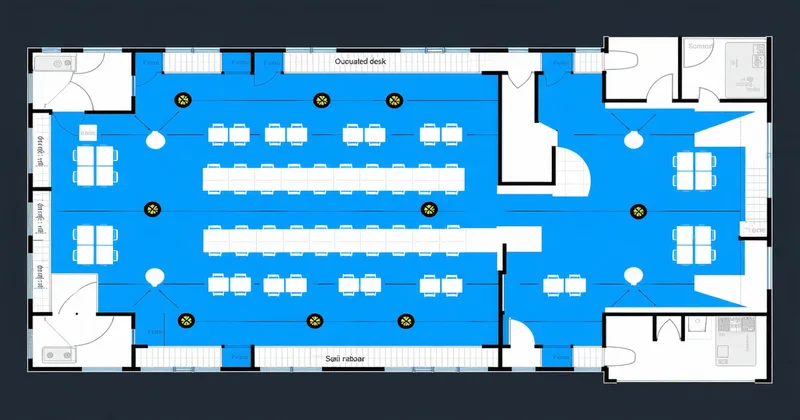
The IWR6843 has a field of view of roughly 120° azimuth and 30° elevation at ceiling mount, which corresponds to a detection cone covering approximately 15–20 sq m from a 3 m ceiling height. For open-plan office use — where the goal is zone-level occupancy count, not individual desk detection — a single node ceiling-mounted at the zone center typically provides adequate coverage. For desk-level utilization tracking in hotdesk or flex-seating environments, node placement must account for the desk array geometry; nodes mounted at 2.5–3 m above desk surface with overlapping coverage from adjacent nodes are needed for per-desk resolution.
False triggers are the primary operational nuisance in any occupancy sensing deployment. For mmWave specifically, the common false-trigger sources are: (1) HVAC air movement through registers near the sensor, which can produce low-amplitude micro-Doppler at breathing frequencies; (2) hanging plants, banners, or light strings that oscillate in air currents; (3) computer fan exhaust near a floor-level or low-mount sensor. The MK-NODE-OCC firmware includes a zone mask configuration that lets you exclude specific range-azimuth-elevation sectors from the detection space. Masking the sector directly beneath an HVAC diffuser, for example, eliminates that false-trigger source without degrading detection in the occupied desk zone.
A practical commissioning approach: during initial deployment, run the sensor in passive logging mode for 24–48 hours without triggering any zone control actions. Review the MeshOS occupancy heat map to identify persistent false-trigger clusters during known-empty periods (nights, weekends). Then apply zone masks to those sectors, run another 24-hour verification pass, and enable the zone control rules. That verification cycle catches the site-specific interference sources before they create occupant complaints.
Privacy Architecture: What the System Stores (and Does Not)
The mmWave radar does not capture images. It processes reflected radio waves into a point cloud of detected objects — (range, velocity, angle) tuples without any visual information. There is no image to store, no face to identify, no biometric data to protect. The node's DSP reduces the point cloud to an occupancy count and a presence boolean before any data leaves the device. The numbers — "2 occupants detected in zone B-07" — are what reach the gateway and the MeshOS dashboard, not spatial coordinates or movement trajectories.
We are not saying mmWave radar raises zero privacy questions. The micro-Doppler signature of a specific individual's breathing and heartbeat rhythm is theoretically a biometric — though extracting it from aggregated zone-level data would require adversarial signal processing well beyond what commodity hardware supports. The practical privacy posture is: on-chip detection reduces raw radar data before it leaves the node, no images are ever created, no personally identifiable information is stored. In our deployments, this architecture has satisfied the data privacy review requirements at every facility where camera systems were rejected.
For EU deployments subject to GDPR, the DPIA (Data Protection Impact Assessment) for a system processing only occupancy count and presence boolean — with no individual tracking capability — is substantially simpler than for camera-based systems. Facilities teams have found that legal review cycles are significantly shorter when the DPA can confirm that no biometric data is collected at the hardware layer.
PIR Hybrid: When to Add Infrared as a Second Layer
The MK-NODE-OCC includes a PIR sensor alongside the 60 GHz radar, and there are deployment scenarios where the hybrid approach adds value. In corridors and transition areas where motion detection (not presence detection) is the primary use case — triggering lighting when someone walks through a space — PIR is more power-efficient and has lower processing latency than waiting for the radar to complete its point cloud pipeline. PIR triggers the initial lighting-on event; the radar then confirms ongoing presence and holds the lighting on while a stationary occupant remains.
The hybrid also provides a cross-validation layer. If PIR and radar disagree on occupancy state for more than 60 seconds, the MeshOS occupancy engine can flag the discrepancy for review — this often surfaces a sensor hardware fault or a coverage gap. A PIR detecting motion but radar reporting no presence could indicate a sensor mounting angle problem on the radar or an obstructed FOV. Conversely, radar detecting micro-Doppler presence but PIR showing no motion confirms a stationary occupant — exactly the case where PIR alone would have timed out.
People Counting Accuracy: Realistic Expectations
A single MK-NODE-OCC with proper zone configuration achieves ±1 count accuracy at occupancy levels of 1–4 people within a 15 sq m zone at 90th-percentile confidence in our field validation data from a 340-seat open-plan office deployment. At higher densities (8–10 people in the same zone), accuracy degrades as individual micro-Doppler signatures overlap and the CFAR detector struggles to resolve distinct peaks. For high-density zones — conference rooms with 10+ seats, lounge areas — the practical recommendation is people-counting via door counter nodes (ultrasonic or IR beam-break at the door threshold) combined with the mmWave sensor for presence confirmation, rather than relying on the mmWave radar for absolute count accuracy in crowded conditions.
Zone-level presence accuracy (at least one person present vs. empty) remains very high — greater than 97% — across all density levels in our deployments. For HVAC setback decisions, where the binary is "is anyone here?" rather than "how many people are here?", that accuracy level is more than adequate for confident setback decisions. It is the per-desk utilization analytics use case that requires the higher-density counting accuracy, and those deployments need different node placement and density planning than zone-level HVAC control.