The 1990s Building Problem
The majority of commercial floor space in the US was built before 2000. Much of it was built before 1995 — before BACnet/IP was a standard, before wireless occupancy sensing was commercially viable, and before anyone thought about using zone-level temperature data to drive variable air volume damper setpoints dynamically. The HVAC systems in those buildings are not obsolete. An air handling unit from 1994 still moves air competently. The DDC (direct digital control) panels wired to the VAV boxes still execute PI loops against fixed setpoints. The problem is the setpoints are still fixed — typically 70°F occupied, 85°F unoccupied, switching on a schedule that has not been updated since the tenant mix changed years ago.
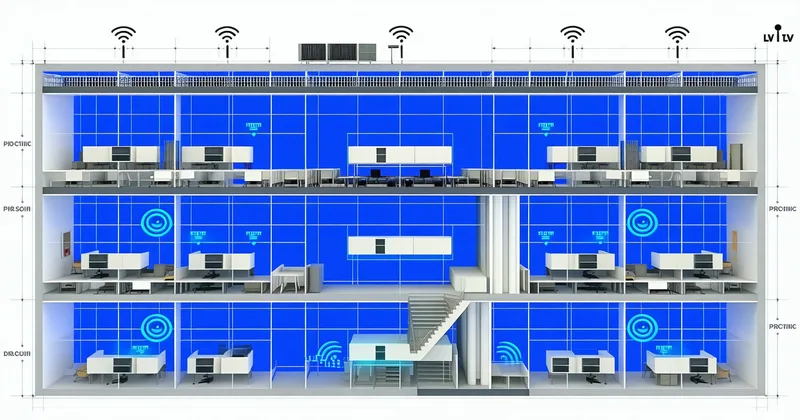
The goal of a wireless HVAC zone control retrofit is not to replace that DDC infrastructure. It is to add occupancy-driven setpoint adjustment on top of it, delivered through the existing BMS integration layer. The wireless mesh provides the occupancy and zone temperature data that the DDC panels could not previously access; the BACnet/IP integration delivers setpoint writes back to the panels; the panels continue executing their own PI loops. The facility manager gains dynamic control without a full BAS replacement project.
RF Propagation in Legacy Construction
Before specifying node counts and gateway placement, a site RF survey is mandatory in buildings with pre-2000 construction. These buildings commonly have poured concrete floor-to-ceiling slabs with embedded rebar, masonry interior partitions, and mechanical rooms with metal equipment clusters. Each of these significantly attenuates 2.4 GHz RF.
Concrete with rebar: measured attenuation typically ranges from 12–20 dB per wall at 2.4 GHz, depending on rebar density and wall thickness. A building core of stairwells and elevator shafts — typically poured concrete — will create RF shadow zones on the perimeter of the floor if gateways are positioned on the opposite side. For a 40,000 sq ft floor with a central concrete core, you need at least two gateway locations to provide full mesh coverage, or a higher relay node density to bridge the RF shadow.
Mechanical rooms present a different challenge: metal ductwork, condensate piping, and fan coil units create multipath and near-field reflections that make RSSI readings less predictable than in open office space. Thread nodes in mechanical rooms often require 2–3 relay hops to reach the gateway through the metal environment; RSSI at the mechanical room boundary may read –75 dBm even with the gateway at the same floor level across the floor plate. Plan for at least one relay node placed just outside the mechanical room door.
VAV Box Control and the Setpoint Write Path
The control path for occupancy-driven HVAC setback runs as follows. An MK-NODE-OCC occupancy node in the zone detects vacancy (occupancy binary input transitions to 0). The MeshOS rule engine, running on the gateway, evaluates the zone vacancy condition and publishes a setpoint write command: occupied setpoint 70°F transitions to unoccupied setpoint 78°F for cooling, 62°F for heating. That command arrives at the MK-GW as a BACnet WriteProperty request targeting the Analog Output object mapped to the VAV box setpoint register in the BMS. The BMS receives the WriteProperty, updates the setpoint for the DDC panel's control loop, and the damper modulates accordingly.
The latency across this path — from occupancy transition to damper response — is roughly: 200 ms for mesh propagation from node to gateway, plus 30–60 seconds for BMS poll cycle acknowledgment, plus 30–120 seconds for the VAV actuator to physically move. Total response from vacancy to damper-at-setback: 1–3 minutes. That is entirely adequate — ASHRAE 62.1 ventilation rates require a minimum outdoor air volume regardless of occupancy, so you cannot ramp ventilation to zero instantly anyway. The setback logic should include a 10–15 minute vacancy holdoff before reducing setpoints, to avoid hunting from transient vacancies.
ASHRAE 62.1 Compliance Considerations
ASHRAE 62.1 (Ventilation and Acceptable Indoor Air Quality) sets minimum outdoor air ventilation rates based on occupant density and floor area. When implementing demand-controlled ventilation (DCV) using occupancy sensor data, the setback logic must maintain minimum outdoor air fractions even in unoccupied zones, unless CO2 monitoring confirms that actual occupancy is zero and has been zero long enough to allow outdoor air reduction within the standard's dynamic reset provisions.
The MeshOS rule engine supports CO2 sensor input — the MK-NODE-TH node has an optional CO2 module — which allows DCV strategies that comply with ASHRAE 62.1 Section 6.2.7. For a retrofit deployment adding CO2-based DCV to an existing building, this must be coordinated with the mechanical engineer of record; modifying outdoor air fractions in a BAS without MER review can void the building's ventilation compliance documentation. The wireless mesh handles the sensing and setpoint delivery; the control strategy validation is an engineering-of-record responsibility.
Commissioning with Existing Control Panels
Legacy DDC panels typically communicate over BACnet MS/TP (master-slave token-passing, RS-485 based) on the field bus layer, with a supervisory controller — sometimes called a network controller — translating to BACnet/IP on the supervisor LAN. The MK-GW integrates at the BACnet/IP supervisor LAN level, not the RS-485 field bus level. This means the gateway never touches the field controllers directly; it writes setpoints to the BACnet/IP objects that the supervisory controller maps down to the field bus.
A specific issue that arises during commissioning: some supervisory controllers have write-protection enabled on setpoint objects by default. The gateway issues a BACnet WriteProperty with priority 8 (Manual Operator in the BACnet priority array), and the request is silently ignored because the object's relinquish default takes precedence. The fix is to enable write access at the appropriate priority level in the supervisory controller configuration — typically priority 8 or 10 for supervisory override. Priority 1 (Manual Life Safety) should never be used for routine setpoint writes; it bypasses all lower-priority control logic including emergency setpoints.
In a typical early-stage commercial retrofit — say, a 12-floor office building running a DDC system with BACnet/IP at the supervisor level — the commissioning sequence is: (1) map existing BACnet objects for each zone's setpoint and occupancy override; (2) deploy mesh nodes and verify coverage; (3) configure MeshOS zone-to-BACnet mapping; (4) test setpoint writes in manual mode before enabling automatic rules; (5) run a one-week parallel operation period where occupancy-driven setpoints log but do not execute. The parallel operation phase catches rule logic errors before they affect occupant comfort.
Measuring the Outcome: What Numbers to Track
HVAC energy reduction from occupancy-driven setbacks is real, but the numbers vary widely depending on baseline occupancy patterns, building envelope, climate zone, and HVAC system efficiency. Common claims of 20–30% HVAC energy reduction from DCV retrofits are plausible in buildings with highly variable occupancy — open-plan offices with significant unoccupied periods, hospitality, higher education. Buildings with consistent high occupancy during operating hours — emergency departments, 24/7 operations centers — see much smaller setback benefits because the occupancy-driven zones rarely enter setback mode.
The metrics worth tracking from the MeshOS dashboard are: setback activation count per zone per day (how often zones actually enter setback), setback dwell time (how long zones stay in setback before reoccupancy), and zone temperature deviation from setback target (did the VAV actually track the setpoint, or is the actuator underperforming). The third metric often surfaces deferred maintenance issues — a VAV box whose actuator has a dead band of ±4°F may be consuming full airflow while appearing in the BMS as "controlled."
We are not saying every HVAC retrofit produces measurable energy savings in the first year. Buildings with poor building envelope, unresolved air balancing issues, or HVAC equipment that is oversized for the current occupancy patterns will see modest setback impact until the underlying system issues are addressed. The mesh sensing layer reveals those issues; it does not solve them. The facility team still needs to use the data.
When Not to Retrofit Wirelessly
There are building types where a wireless HVAC zone control retrofit is the wrong approach regardless of the mesh technology. Buildings with no existing BACnet/IP supervisory layer — still running pneumatic actuators, or DDC panels with proprietary RS-232 supervisory ports that predate open protocol adoption — require a supervisory controller upgrade before wireless mesh integration makes sense. The wireless layer delivers setpoints; if there is nothing on the receiving end that can accept a BACnet WriteProperty and translate it to a damper signal, the integration chain is broken at the BMS, not at the mesh.
Similarly, buildings where the HVAC zones are so large (single VAV serving 5,000+ sq ft open floorplate) that zone-level setback produces minimal energy benefit are poor candidates for a zone control retrofit. The benefit of occupancy-based DCV scales with zone granularity; if each zone is already large enough to average out occupancy variations, the incremental benefit of adding occupancy sensing is small. In those buildings, a simpler scheduling update — adjusting the BAS schedule to match actual occupancy patterns observed over a monitoring period — may deliver comparable savings at lower infrastructure cost.