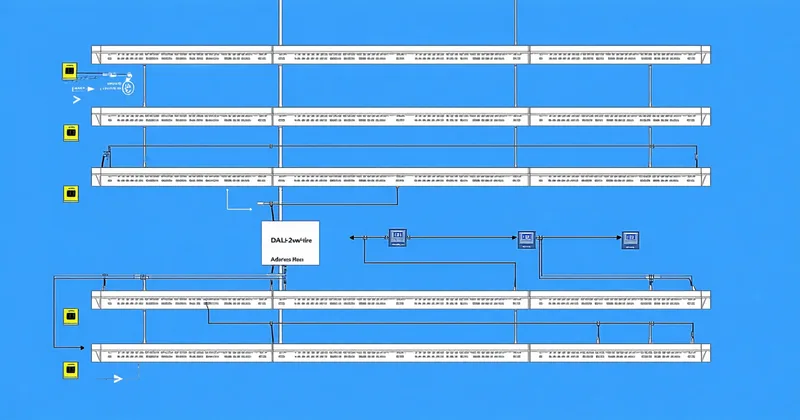
What DALI-2 Actually Gives You
DALI (Digital Addressable Lighting Interface), now in its second major revision as IEC 62386-based DALI-2, is the protocol that handles everything from individual luminaire dimming to emergency lighting testing in commercial buildings. Where older 0–10V analog dimming gives you zone-level control at best, DALI-2 gives you up to 64 individually addressed devices per DALI bus, two-way communication (the controller can query current dim level, lamp fault status, and emergency mode state), and standardized device type profiles so ballasts and drivers from different manufacturers interoperate without vendor-specific configuration.
DALI-2 certification under IEC 62386 Part 103 added an application controller requirement — the bus controller must be a certified device, not arbitrary custom firmware. This matters because pre-DALI-2 gear from the early 2010s often used informal "DALI 1" implementations that partially comply but do not meet the certification tests. When commissioning a mixed-vintage luminaire fleet, it is worth verifying DALI-2 certification compliance per individual device, not just per manufacturer product line.
The Bus Topology and Its Hard Limits
A DALI bus is a two-wire, polarity-insensitive loop carrying data at 1200 bps (Manchester-encoded). Maximum bus current is 250 mA, which limits the number of devices powered from the bus itself — 64 short addresses are the absolute maximum, but bus power constraints often limit the practical maximum to 40–50 devices on a single run without an auxiliary bus power supply. Cable length limits depend on conductor cross-section: at 1.5 mm², the specified maximum is 300 m total loop length; at 0.5 mm², around 100 m. Most office floor installations work comfortably within these bounds.
The 64-address limit is per bus, not per building. A large office floor might have 4–6 DALI buses controlled from a central DALI application controller (or a gateway acting as application controller). Each bus manages its own address space independently. When you bridge multiple DALI buses onto a Bluetooth Mesh backhaul, the mesh layer handles the address namespace expansion — a BT Mesh model instance on the gateway maps to a specific DALI bus and short address, giving you a flat virtual address space across all buses while preserving per-bus addressing on the wire.
How the Bluetooth Mesh to DALI-2 Gateway Works
The MK-NODE-BT node includes a DALI-2 master port alongside its Bluetooth Mesh 5.x radio. In the gateway role, it operates as the DALI-2 application controller on its local bus, while simultaneously acting as a BT Mesh node that receives scene and group control commands from the mesh backhaul. A scene command published on BT Mesh model address 0xC001 arrives at the node, gets decoded against the local scene table, and translates to a DALI-2 DAPC (Direct Arc Power Control) or Go-To-Scene command sent down the two-wire bus to all subscribed luminaires.
The address binding is configured during commissioning through MeshOS. You assign each DALI short address (0–63) a corresponding BT Mesh element address and model instance. Groups are defined both at the DALI level (DALI Group Address, 0–15) and at the BT Mesh level (BT Mesh group address, 0xC000–0xFFFF). Scene tables can be configured in both layers — scenes can be triggered either by a BT Mesh scene recall command propagating through the wireless backhaul, or by a local occupancy signal at the DALI controller itself if you want local-only fallback operation when mesh connectivity is unavailable.
A 600-Luminaire Office Floor: What to Expect
An open-plan office floor with 600 luminaires — a realistic number for a large 40,000 sq ft floorplate — typically breaks down as 8–10 DALI buses, 60–80 devices per bus, with separate buses per lighting zone (perimeter, interior, meeting rooms, circulation). During commissioning of a deployment like this, several patterns consistently arise.
First, bus fault isolation. On a 600-device installation, at least 2–3 buses will have wiring faults discovered during commissioning — usually a ballast with a cut data wire or a connector not seated fully, which puts the bus into a constant collision state where no devices respond. The DALI-2 bus diagnostic in MeshOS shows bus voltage, current draw, and collision count per bus, which lets you triage faulty buses without walking every luminaire. A bus drawing close to 0 mA with normal voltage usually indicates an open circuit; a bus with high current draw and zero device responses usually indicates a short.
Second, short address conflicts. If the lighting contractor commissioned addresses without a proper DALI programmer, it is not uncommon to find duplicate short addresses on the same bus — two ballasts answering to short address 12, for example. DALI-2's commissioning procedure includes a randomize-and-program sequence that assigns unique short addresses without conflicts, but some contractors skip this step. Running MeshOS's DALI bus scan before finalizing the address binding catches duplicates early.
Third, scene table size. DALI-2 supports 16 scenes per device (scene numbers 0–15). For a building with more than 16 lighting scenes across the whole floor — common in mixed-use spaces — you need to think carefully about how scenes are allocated across DALI group addresses and BT Mesh group models. We generally recommend keeping scene count to 8 or fewer per DALI zone and using BT Mesh group addressing to aggregate zone scenes into building-level scenes at the mesh layer.
Tunable White and the DALI-2 DT8 Device Type
Tunable White luminaires — those that can shift color temperature across a Kelvin range (typically 2700 K to 6500 K) — require DALI-2 Device Type 8 (DT8) support on the ballast or driver. DT8 extends the standard DALI command set with color temperature and XY color point commands. Not all DALI-2 certified devices support DT8 — it is an optional extension. When specifying luminaires for tunable white control, confirming DT8 certification (rather than just DALI-2 certification) is a pre-procurement checkpoint that is easy to miss.
The MK-NODE-BT's DALI master port supports DT8 commands. Circadian rhythm lighting schedules — common in healthcare and workplace wellbeing applications — are managed as time-indexed Tunable White scenes in MeshOS, which publishes color temperature updates to BT Mesh group addresses on a configurable schedule. The update interval for circadian schedules is typically 15–30 minutes; DALI-2 DT8 color temperature transitions are applied with a DALI fade time to avoid perceptible jumps.
Emergency Lighting: UL 924 and the Commissioning Requirement
Emergency lighting compliance adds a layer of complexity that is often underestimated during design. In the US, UL 924 (Standard for Emergency Lighting and Power Equipment) governs the performance requirements for emergency luminaires — specifically the self-test functionality where each luminaire periodically verifies battery backup duration. DALI-2 Part 202 (emergency lighting application controller) defines the standard protocol for initiating and reading emergency test results via the DALI bus.
We are not saying wireless mesh control and emergency lighting compliance are incompatible. They are compatible, and DALI-2 Part 202 gives you the protocol primitives to run emergency function tests, read test results, and log pass/fail status per luminaire. The nuance is that emergency lighting circuits must remain powered independently of the normal lighting circuit — the DALI data bus can run over the same wiring, but the luminaire's battery backup must charge from an unswitched circuit. The wireless mesh backhaul does not affect this: the gateway can query emergency test status over BT Mesh, which triggers a DALI Part 202 function test command on the bus, which the luminaire executes locally against its battery. Results come back via DALI query commands.
In practice, emergency lighting commissioning requires integration with the facility's life safety systems and sign-off by the authority having jurisdiction (AHJ). The mesh + DALI-2 layer handles the automated testing protocol; the life safety compliance documentation requires a licensed electrical contractor and AHJ inspection regardless of the control technology used.
Where DALI-2 over Mesh Breaks Down
Mesh-bridged DALI-2 adds a layer of indirection that purely wired DALI does not have. If the BT Mesh backhaul is congested or a relay node fails, the latency from the mesh command to the DALI bus response increases. For standard lighting control, this is rarely perceptible. For emergency lighting test queries — where the application controller is polling each device sequentially for test result status — the round-trip time per query increases, which can slow down full-floor emergency test completion from the expected ~5 minutes to 10–15 minutes on a large deployment. This is a commissioning workflow issue, not a safety issue, but it is worth building into the testing schedule.
The practical floor for mesh reliability in a DALI-bridged deployment: maintain relay node density such that any DALI controller node has at least two relay paths to the gateway. MeshOS shows relay path count per node in the mesh topology view. Nodes with fewer than two viable relay paths should be flagged during commissioning and either an additional relay node placed, or the DALI bus controller relocated.