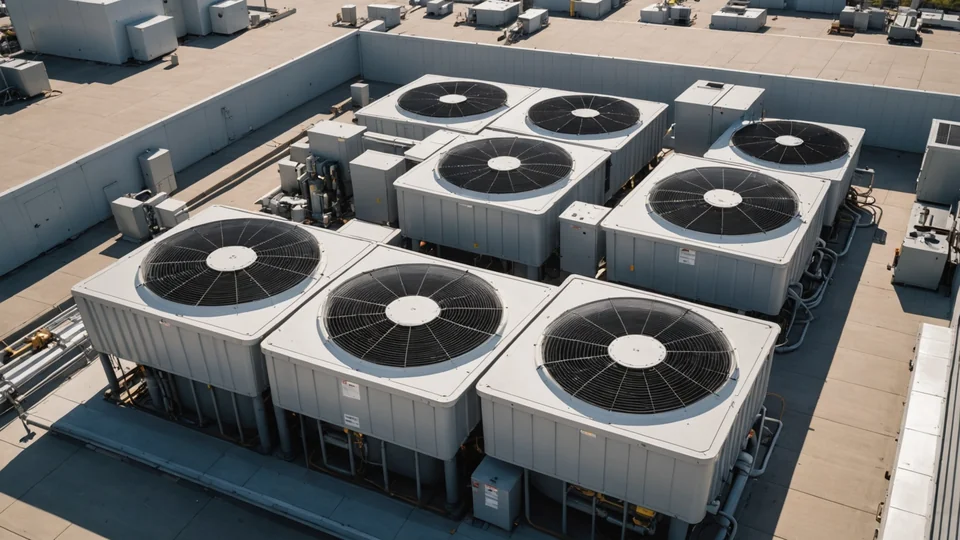
Walk through a typical commercial facility at 2:30 a.m. and you will likely find the HVAC system running at full capacity in zones nobody has occupied for six hours. The loading dock area is getting cooled to 68°F. The conference wing is being heated because somebody left a thermostat override in place after a meeting last Tuesday. Nobody knows, because the building automation system logs this data to a proprietary dashboard that the night crew does not check and the day shift inherits without context.
This is the HVAC energy waste problem in its most common form. It is not dramatic. It does not trigger alerts. It just runs quietly, adding $1,800 to $4,200 per month to energy bills that facility teams assume are roughly correct.
Why Traditional HVAC Monitoring Misses the Waste
Most buildings have some form of building automation system managing their HVAC. The issue is not that the system lacks data — it is that the data is locked in a vendor-specific controller with limited export capability, no floor-map context, and no occupancy correlation. You know the equipment is running. You do not know whether it should be.
We have talked with facility managers who describe checking their BAS dashboard first thing every morning as a ritual that produces very little actionable information. The dashboard shows current setpoints and equipment status. It does not show you that AHU-3 has been running 14% above its baseline energy draw for the past 11 days — the early signature of a failing damper actuator causing it to work harder to maintain setpoint.
The gap between "data exists" and "waste is visible" is the gap that IoT monitoring fills. Adding zone-level current sensors, occupancy detection, and airflow monitoring on top of the existing BAS layer turns raw equipment status into a picture of where energy is being spent relative to where it needs to go.
What Zone-Level Consumption Data Actually Shows
When we instrument a facility with granular zone-level energy monitoring, the first 30 days of data almost always reveal the same three categories of waste:
- Scheduling drift: HVAC schedules that were set correctly at commissioning and have drifted over months of manual overrides and schedule exceptions. A zone scheduled to unoccupied mode at 6 p.m. may have accumulated a dozen manual overrides that never got reversed. In our experience, scheduling drift accounts for 15–22% of HVAC energy waste in mid-market commercial facilities.
- Dead zone conditioning: Storage rooms, server corridors, loading areas, and unfinished spaces being conditioned to the same setpoints as occupied office areas. These zones collectively represent 8–15% of total facility floor area in a typical warehouse or mixed-use commercial building.
- Equipment degradation signals: HVAC units drawing 10–18% more power than their baseline to maintain the same setpoint — the thermal signature of clogged filters, failing dampers, refrigerant charge issues, or compressor inefficiency. Equipment running harder than it should costs money before it fails catastrophically.
The numbers add up fast. In a 60,000 square foot manufacturing facility consuming roughly 850,000 kWh per year on HVAC, a 20% waste reduction is worth approximately $18,700 annually at $0.11/kWh average commercial rates — before accounting for demand charge reductions from more consistent load profiles.
How IoT Monitoring Makes Waste Visible Without a Retrofit
The value of an IoT mesh layer on top of an existing BAS is that it does not require replacing the building automation system. Meshkindle nodes install at structural anchor points — typically one per 2,500–4,000 square feet of facility — and connect to existing BACnet and Modbus devices via hardware bridge adapters. The BAS continues doing what it does. The mesh layer adds the visibility context that makes its data meaningful.
Zone-level energy monitoring works by adding current sensors to HVAC branch circuits and correlating that consumption data with occupancy signals from motion detectors, access control events, or Wi-Fi probe requests. When AHU-7 draws 4.2 kWh during a three-hour window when the zone it serves has zero occupancy events, that appears on the floor-map dashboard as an orange zone — not buried in a log file, but visually overlaid on the floorplan at the location where the waste is happening.
This spatial context matters more than people expect. Facility teams respond to problems on a floor plan in a way they do not respond to anomalies in a data table. Seeing a glowing orange zone on the east wing at 2 a.m. is immediately actionable. A row in a spreadsheet showing "AHU-7: 4.2 kWh unoccupied hours" gets investigated eventually.
Alert Thresholds That Actually Work for HVAC
One thing we learned early in our deployments is that HVAC energy alerts need to be tuned carefully or they become noise. A simple threshold alert — "alert if any HVAC unit draws more than X kWh" — will fire constantly during seasonal transitions, occupancy spikes, and weather anomalies. Facility managers stop looking at alerts that fire ten times a day.
Effective HVAC energy monitoring uses baseline-relative alerting: the system learns each equipment unit's normal consumption pattern over a 14-day calibration period, accounting for time of day, day of week, and outdoor temperature correlation. Alerts fire when consumption deviates from the learned baseline by more than 12% for more than 45 consecutive minutes — not when it crosses an absolute threshold that was set once at commissioning and never updated.
This approach reduces nuisance alert rate by roughly 70% compared to static threshold alerting, while catching the equipment degradation signals that matter: the slow drift of a damper losing its seal, the compressor that starts drawing 15% more current three weeks before it fails completely.
The alerts that matter are not the ones that shout at you when something breaks. They are the quiet ones that tell you something is drifting before it costs you a weekend emergency repair call and a ruined production schedule.
— Felix Brunner, CEO & Co-Founder, Meshkindle
Integrating HVAC Monitoring With Predictive Maintenance
Energy consumption data is one of the most reliable early indicators of HVAC equipment health. A compressor running hot draws more current. A fan with a failing bearing develops vibration harmonics that show up in power quality data before they are audible. A heat exchanger losing efficiency requires longer run times to reach setpoint — visible as an extended duty cycle in consumption trending.
When IoT monitoring captures both energy consumption and vibration telemetry from the same equipment, the predictive maintenance signal becomes much stronger. A compressor showing a 14% increase in current draw combined with a 0.3 g RMS increase in vibration amplitude at 1x running speed frequency is not a maybe — it is a scheduled maintenance call before the next production week, not an emergency shutdown on a Friday afternoon.
Our deployments have documented HVAC-related unplanned downtime reductions of 55–70% in facilities that operated on reactive maintenance cycles prior to IoT instrumentation. The energy savings and the maintenance savings frequently stack: the equipment that was running harder was also the equipment most likely to fail.
Getting Started Without Overwhelming Your Operations Team
The practical barrier to HVAC IoT monitoring is not technical — it is operational. Facility teams are stretched thin. Adding another monitoring layer means adding another system to learn, another alert queue to manage, and another vendor relationship to maintain.
The way we recommend approaching this is to start with the highest-consumption HVAC equipment in the facility: the air handling units and chillers that together account for 60–75% of total HVAC energy draw in a typical commercial building. Instrument those units first, establish baselines, and let the system run for 30 days before expanding coverage. By the time you add zone-level monitoring for the full floor plan, your operations team has already seen the dashboard, responded to real alerts, and built the workflow muscle memory to handle the expanded data without being overwhelmed.
The first thing most facility teams discover after 30 days of HVAC energy monitoring is not the catastrophic waste they feared they might find. It is the steady, invisible drain that has been there for months — the 2 a.m. cooling cycle in an empty zone, the AHU that has been working 12% harder than it needs to for the past six weeks. That visibility, by itself, pays for the monitoring infrastructure within the first year at most facility sizes above 25,000 square feet.